General Information:
PLEASE NOTE.... AS FROM FRIDAY 4 AUGUST 2023, (subject to certain restrictions, such as sanitising hands after each dance, and bringing your own water bottle) classes will start at 10am, concluding at noon. The last Friday night class will be 28 July 2023. You are welcome to wear a mask if you wish. In the now unlikely event of a lockdown or severe restrictions on dancing, classes will be suspended.
We will meet each Friday, March to November inclusive (except Good Friday) at 10am.
The venue is: St James' Anglican Church Hall, 17 Station Street, Wellington Point. (the hall backs onto the Wellington Point Railway Station - see the Google map in the Location folder)
The fee for the class each day is $6.
PLEASE NOTE.... AS FROM FRIDAY 4 AUGUST 2023, (subject to certain restrictions, such as sanitising hands after each dance, and bringing your own water bottle) classes will start at 10am, concluding at noon. The last Friday night class will be 28 July 2023. You are welcome to wear a mask if you wish. In the now unlikely event of a lockdown or severe restrictions on dancing, classes will be suspended.
We will meet each Friday, March to November inclusive (except Good Friday) at 10am.
The venue is: St James' Anglican Church Hall, 17 Station Street, Wellington Point. (the hall backs onto the Wellington Point Railway Station - see the Google map in the Location folder)
The fee for the class each day is $6.
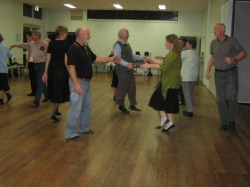
You do not need to bring a partner, as we generally dance in groups/sets of 6 (3 facing 3) or 8 (4 facing 4) - in fact, the Scottish Country Dance etiquette is that you share yourself around with as many dancers as possible during the course of the class.
The class is informal - ladies skirts/shorts; men shorts (longs in the cooler weather) and flat, comfortable shoes. As long as you are reasonably fit and can dance to the beat of the music, you will enjoy the experience.
Better still, Scottish Country Dancing is recommended by the Heart Foundation, and is almost guaranteed to slow down the onset of dementia!!
The class is informal - ladies skirts/shorts; men shorts (longs in the cooler weather) and flat, comfortable shoes. As long as you are reasonably fit and can dance to the beat of the music, you will enjoy the experience.
Better still, Scottish Country Dancing is recommended by the Heart Foundation, and is almost guaranteed to slow down the onset of dementia!!
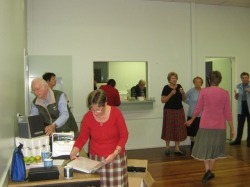
We dance from 10am until about noon.
Visitors from other clubs are very welcome.
We have full Public Liability Insurance coverage, in the highly unlikely event of some accident occurring.
Visitors from other clubs are very welcome.
We have full Public Liability Insurance coverage, in the highly unlikely event of some accident occurring.
What is Scottish Country Dancing?
Scottish Country Dancing actually originated in France a few hundred years ago, and has evolved to what it is today, a combination of movements such as right-hands-across (otherwise known as wheels or stars), turns by the left hand and right hand, circles, reels, rights and lefts, and many other formations, which go to make up the various dances. If you have ever watched square dancing, the movements are very similar - in fact, square dancing evolved from Scottish Country Dancing.
Most dances are performed in what is called a 4-couple set, where the 4 ladies stand opposite the 4 men, partner facing partner. The couple closest to where the music is playing is called the first couple, and so on down the line to the fourth couple. The dance generally starts with the first couple doing most of the dancing for the first 32 bars of music, with support from the other couples in the set. Each couple has the opportunity to take their turn to do the dance. Unless the dance is very well-known, a walk-through of the dance is conducted for each couple before the music is turned on.
You will be taught travelling skip-change steps to reel and jig beat, and to the slower, more elegant strathspey beat, as well as setting steps for the various types of music.
Most dances are performed in what is called a 4-couple set, where the 4 ladies stand opposite the 4 men, partner facing partner. The couple closest to where the music is playing is called the first couple, and so on down the line to the fourth couple. The dance generally starts with the first couple doing most of the dancing for the first 32 bars of music, with support from the other couples in the set. Each couple has the opportunity to take their turn to do the dance. Unless the dance is very well-known, a walk-through of the dance is conducted for each couple before the music is turned on.
You will be taught travelling skip-change steps to reel and jig beat, and to the slower, more elegant strathspey beat, as well as setting steps for the various types of music.
